The Science Behind Jeani
From Your Joints,
To Your Wrist.
How Jeani uses wrist-worn inertial sensor data to derive validated gait metrics and joint-specific musculoskeletal loading estimates, with no specialist equipment required.
It starts with a wrist-worn inertial sensor.
Every wrist-worn wearable equipped with a triaxial accelerometer continuously captures raw motion data across three orthogonal axes (vertical, anterior-posterior and mediolateral) throughout your walk or run.
These signals, measured in gravitational units (g), encode the mechanical forces acting on your body with every stride. No additional hardware needed. Your wearable is already the sensor.
Wrist acceleration as a validated gait proxy.
Raw acceleration signals contain periodic, rhythmic structures that encode the temporal architecture of human locomotion. Using autocorrelation analysis, power spectral density decomposition and validated step detection algorithms, Jeani extracts core gait features: cadence, stride regularity, vertical oscillation amplitude, gait symmetry index and harmonic ratio.
Together, these features form a validated gait proxy: an evidence-based surrogate for the biomechanical assessments typically performed in specialist motion analysis laboratories, now available continuously, in the real world.
Gait features resolved into joint-specific estimates.
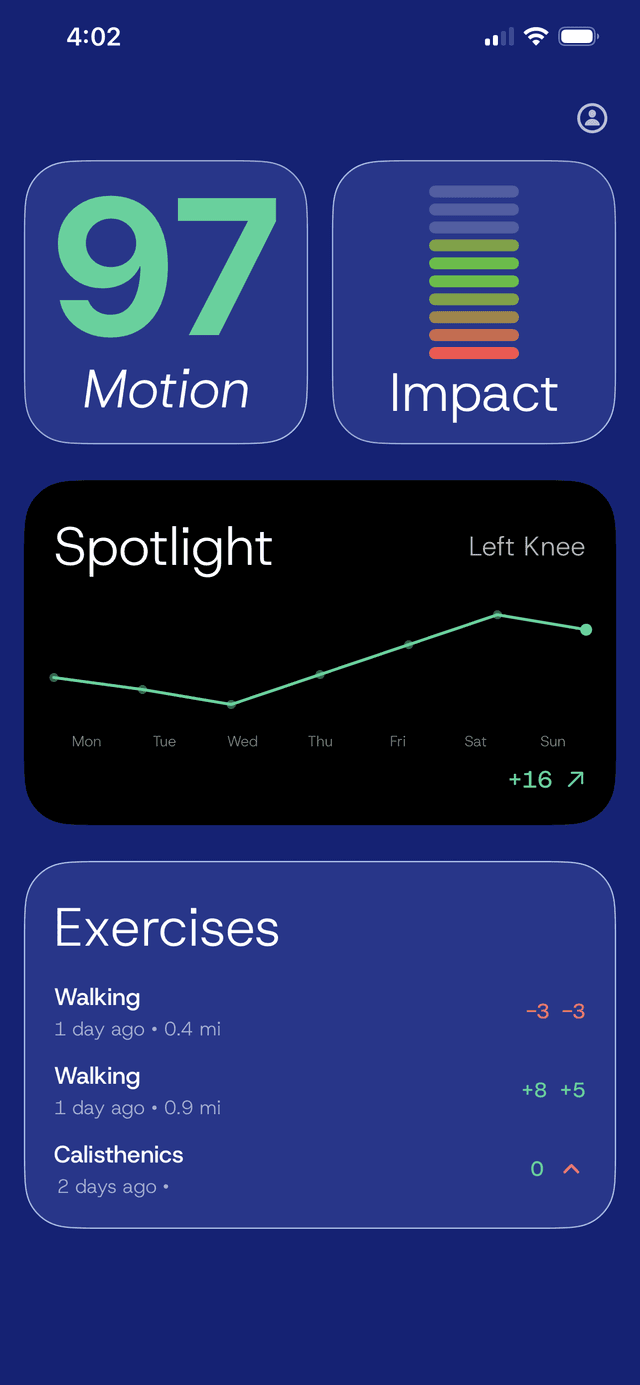
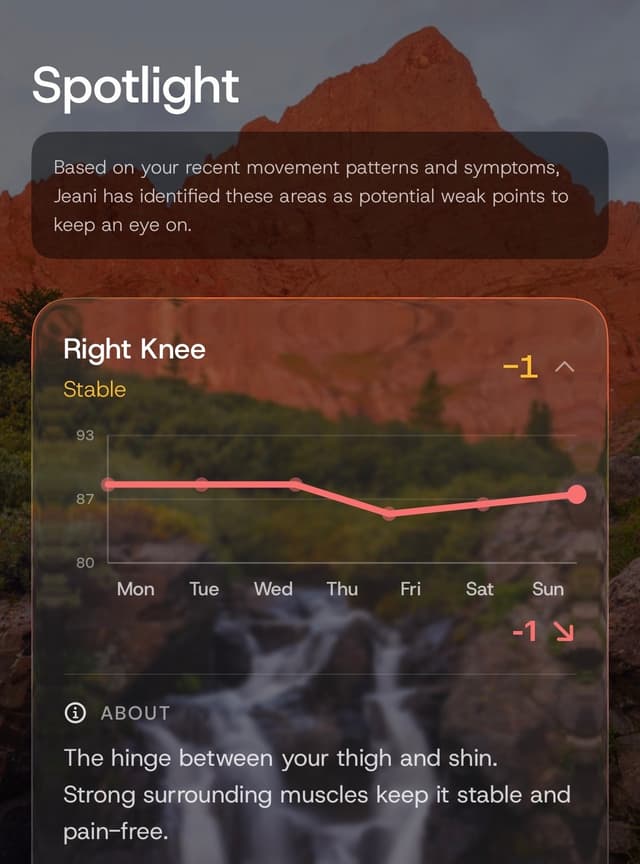
Extracted gait features are passed through Jeani's foundation model to derive proxy measures of musculoskeletal loading and inter-limb asymmetry, estimating how mechanical stress is distributed across the hip, knee and ankle, bilaterally, across each session.
These are statistically validated estimates, not direct measurements of joint kinematics, consistent with the methodological approach used in published clinical and sports science research on wearable-based gait analysis.
Why it matters
One sensor. Six joint estimates. Every session.
Sensor-agnostic methodology
Jeani's analysis pipeline is compatible with any wrist-worn accelerometer: smartwatch, fitness tracker or research-grade wristband. No proprietary hardware required.
Ecological validity
Real-world gait measurement in naturalistic conditions captures movement variability as it actually occurs, not constrained by a treadmill or laboratory protocol.
Longitudinal sensitivity
Single-session assessments miss the picture. Tracking gait metrics continuously reveals clinically meaningful changes in stride regularity, symmetry indices and loading estimates over time.
Free to download
Start your gait analysis today.
Compatible with any wrist-worn accelerometer. No clinic, no lab, no specialist equipment.