
Generalist movement intelligence
Thorpe 1.5
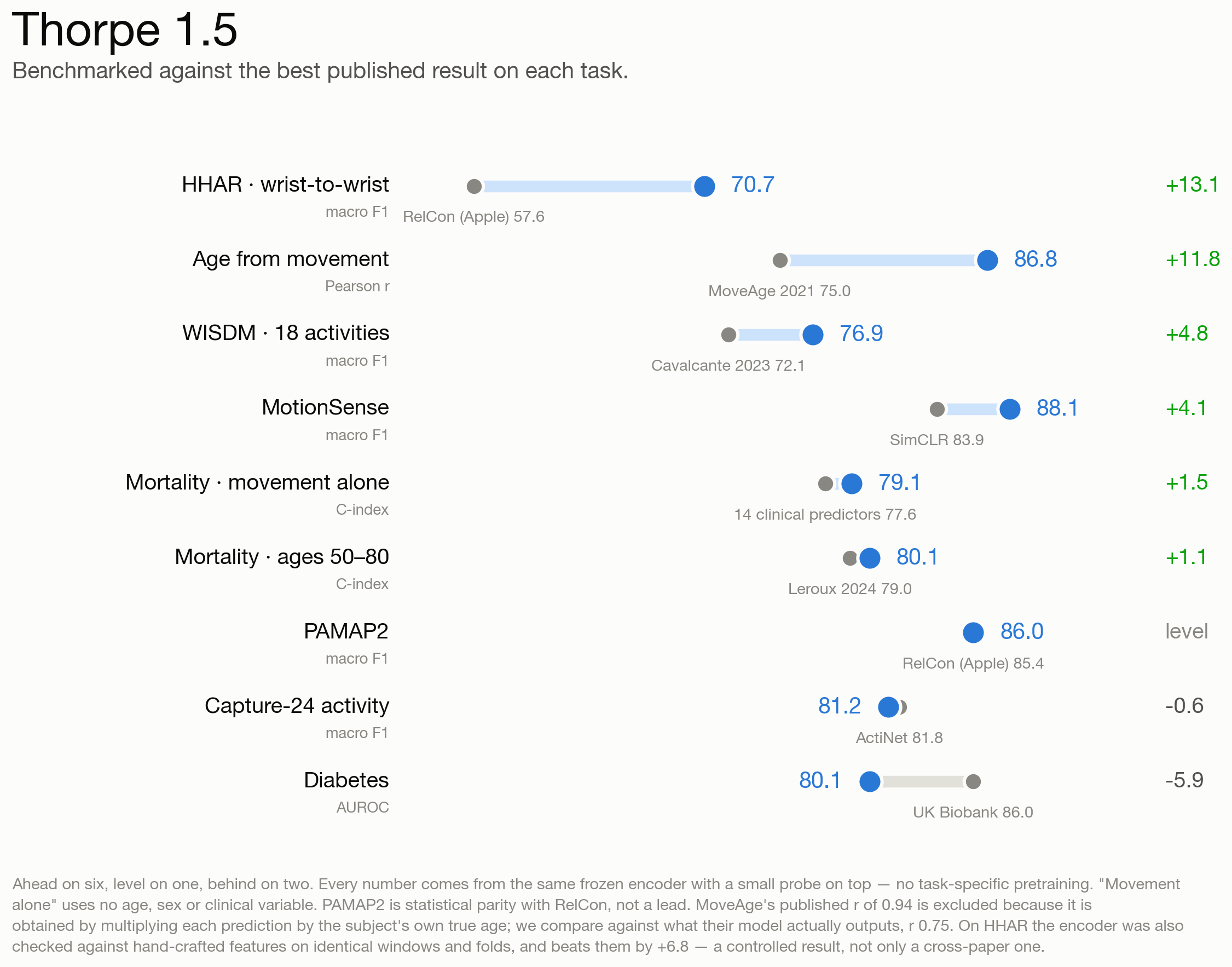
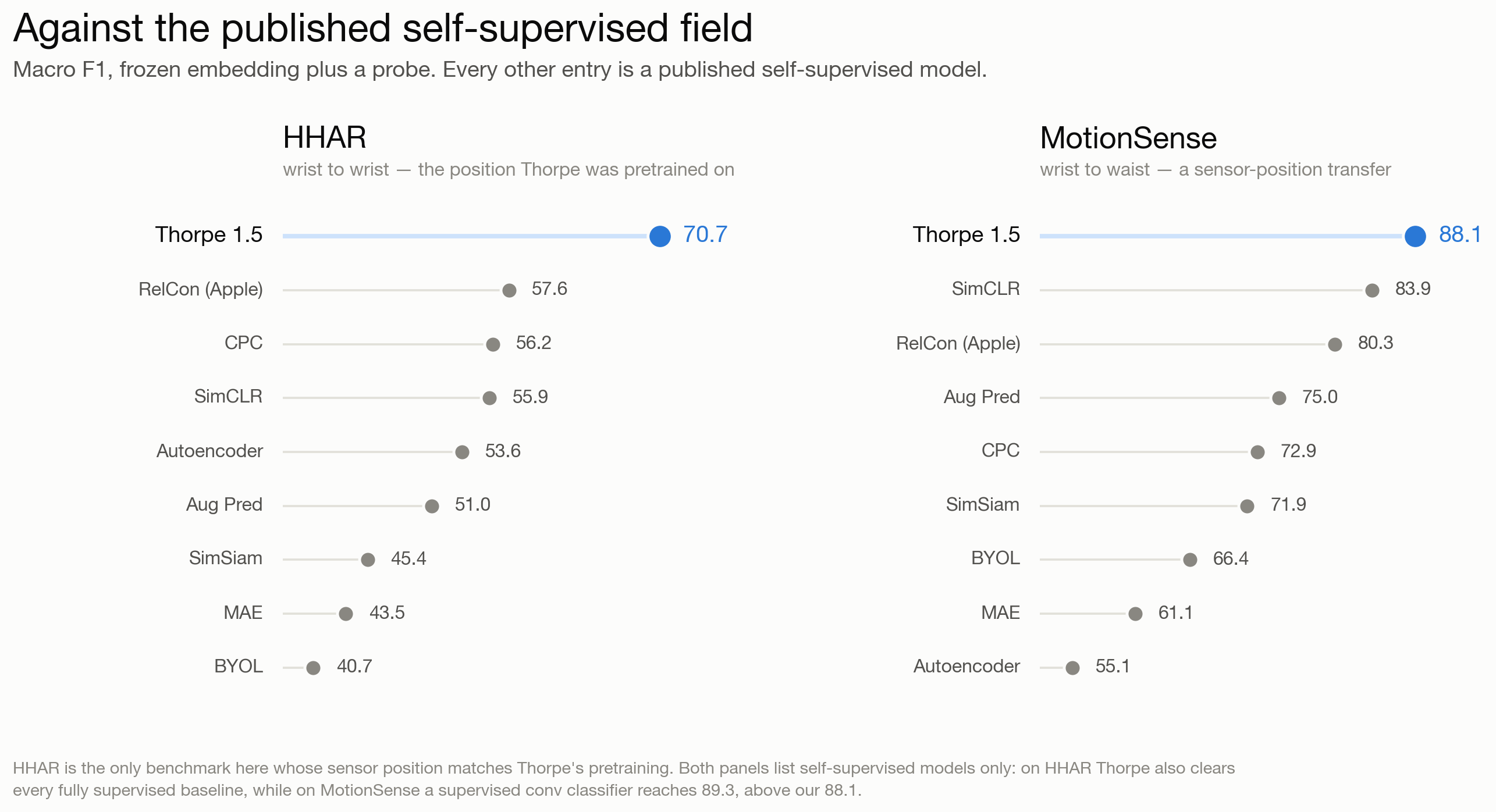
Today we announce the latest version of Thorpe, a 25M parameter model dedicated to understanding human movement. We achieve results matching or exceeding the state of the art in diverse settings, from activity detection to mortality prediction. Given the broad nature of the tasks Thorpe excels in, we believe it to be the best human movement model in the world. We achieved this on a fraction of the training data available to other models which, combined with our research on the scaling laws of movement models, gives us confidence that scaling up will lead us to new frontiers in movement intelligence.
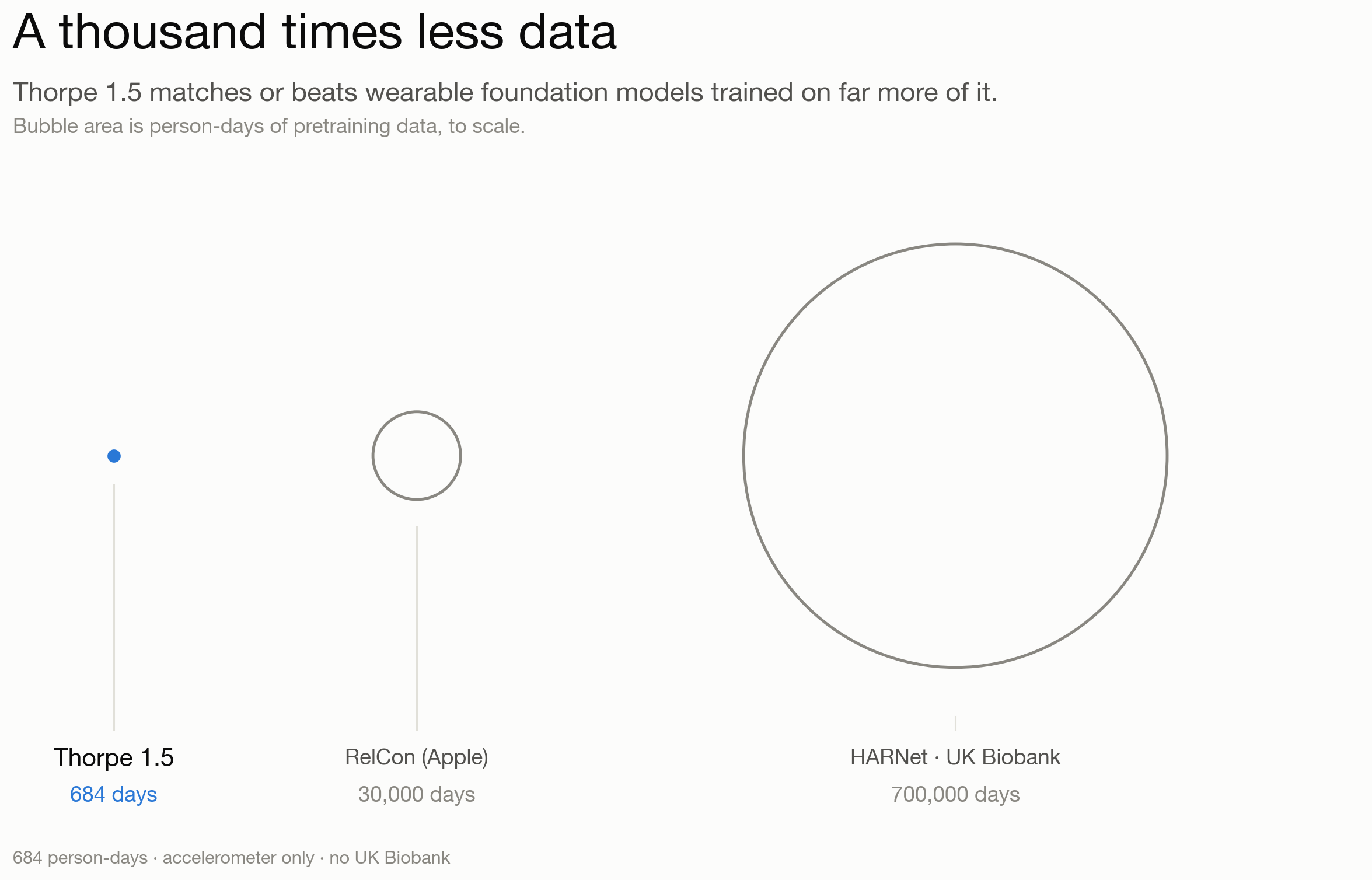
Scaling is the closest thing we get to guaranteed returns in machine learning. This is no secret, huge swathes of the world’s investment capital has been deployed in service of the scaling laws. More data, more GPU’s, more parameters. The problem with almost guaranteed success is you miss the more hard won gains that might serve you well later down the line. The easy lever is often pulled prematurely. Our training data recently amounted to 0.1% of the UK biobank, a source used to train most movement models we compare to. This presented an interesting challenge to us; how close can our models get to state of the art with one thousandth of the training data? The results were better than we could have expected.
Thorpe 1.5 is an encoder trained on roughly 16,000 hours of wrist accelerometer data. We rely mostly on pertaining with custom heads added on to the end for specific tasks. While we do not share the pertaining recipe we do share the details of the custom heads used for each task.
| Task | Head | Selection | Pooling / input |
|---|---|---|---|
| HHAR (70.7) | LogisticRegression C=0.1, class_weight="balanced", max_iter=3000 |
Nested: chosen on an inner subject split from training folds only. Linear-only arm is the headline; a free arm allowing MLPs reached 72.2 | mean+max over 4 tokens (2 s) |
| MotionSense (88.1) | Mixed by fold — mlp_256, logistic_C0.1, mlp_512_256 |
Same nested procedure over 5 candidates (3 logistic C∈{0.1,1,10}, 2 MLP) | mean+max, 4 tokens (2 s) |
| PAMAP2 (86.0) | Two probes reported: logistic C=1.0 → 86.33 pooled; mlp_256 (early stopping) → 87.06 |
Both reported, not selected — LOSO over 8 subjects | mean+max, 20 tokens (10 s) |
| WISDM 18-class (76.9) | LogisticRegression, class_weight="balanced" |
Fixed a priori, no selection. --classifier also offers RidgeClassifier α=1.0 |
5-fold subject-held-out |
| Mortality (0.791 / 0.801) | CoxPHFitter(penalizer=0.1) |
5×5 repeated CV | — |
| Diabetes (0.801) | HistGradientBoostingClassifier, max_iter=400, lr=0.04 |
— | on PCA-64 of embeddings + age/BMI/waist/sex |
| Movement-age (r 0.868) | RidgeCV(alphas=[1,10,100,1000]) |
5-fold | — |
| BMI (r 0.789) | RidgeCV |
same | — |
| PADS Parkinson’s (0.824) | LogisticRegression, class_weight="balanced" |
5×5 subject-level CV | — |
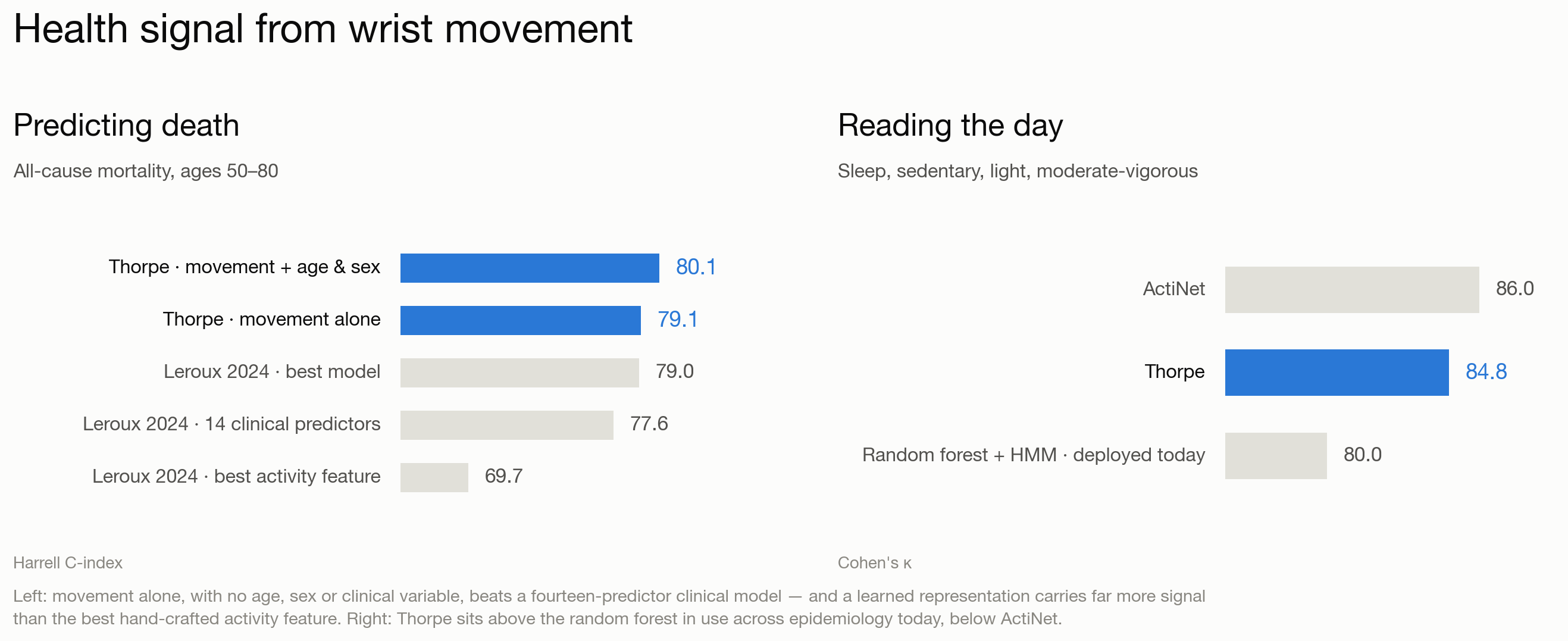
Mortality benchmarking is the result we’re most excited about, despite the morbid nature. Obviously, the goal here is not some personalized death clock a la In Time. Rather, the ability for this model to infer age whether through direct prediction or from all cause mortality suggests latent capabilities in the model to understand the underlying biology of the human body. Movement contains a lot of information about the state of our body that we are beginning to be able to uncover.
We investigated early scaling laws for movement models. With each 10x of data we observe around 9% lower pertaining loss, translating to large returns in downstream results. These models need vast mounts of data to scale up parameter size. Thorpe 1.5 was trained for ~$60 including benchmarking costs. We utilized some open source data combined with our own dataset, as mentioned earlier this pales in comparison to the UK biobank. We plan to train a bigger model utilizing the biobank in the next few months. This will require significantly more compute which these results give us confidence to spend on. The main lesson from these experiments is data is the limiting factor, collecting more is extremely important. Further research will follow as we attempt to find chinchilla scaling laws for this field.
Benchmarking this model was not easy, the available datasets are thin and the objectives slightly mundane. We will be releasing our own benchmarks, but in order for objective evaluation to take place we need larger datasets with more complex objectives to push the frontier further.
We will be integrating Thorpe 1.5 into our products over the coming weeks. This model allows us to enrich Jeani products and serve our ultimate goal, to keep people active for longer. We believe better movement starts with understanding movement, and this is a significant step in that direction. If you want to begin your movement longevity journey, while supporting this research, download Jeani for Apple Watch.